Showing posts with label case sealers. Show all posts

Thursday, November 1, 2012

Where the Food Packaging Market is Going: Edible Packaging


The packaging market is continually evolving, but while most other industries focus  on the most advanced taping machines and carton sealing machines, the food packaging is taking a different, somewhat surprising, direction. The latest in the food packaging market is something called ‘Wikicell’, an edible form of food packaging invented by David Edwards, a professor at Harvard University.
WikiCell works a bit like skin; it can protect any liquid, foam, or solid food that it holds. To make this possible, the material has two layers. The first is like a soft skin made from tiny food particles taken from natural sources such as fruit, nuts, chocolate, and seeds, as well as a nutritious ion-like calcium, plus a natural molecule, which can either be chitosan or alginate. The result is a layer of electrostatic gel that can hold water or other beverages inside.
The second layer, on the other hand, is the outermost layer and serves as a harder shell around the first layer. There are two kinds of this edible shell. The first is the edible type, which is made of a kind of sweetener called isomalt. The other kind is not edible but is completely biodegradable; it is made of either tapioca or baggase, which is the substance left over when sugar is removed from sugar cane.
So depending on the kind of WikiCell packaging used, the shell can be eaten or peeled off and thrown away. Either way, there is no need to worry about solid waste. Even if the outer WikiCell shell cannot be eaten, since it is made from natural ingredients, it is completely biodegradable and is certainly a better option compared to plastic or carton packaging.
What’s truly interesting about WikiCell is that it can not only be used to hold solid food, but also beverages. There are two ways to consume drinks that are encased in the WikiCell. The first is when the WikiCell is small enough, so all you have to do is toss it into your mouth. The second is when the WikiCell is far too large to be consumed like a grape; in this case, you can actually use a straw.
The WikiCell is now in its latter stages of development and sooner or later, you might be able to enjoy ice cream wrapped in WikiCell. The good news is, once the other shell is removed, the ice cream, which would still be wrapped in the inner WikiCell layer, will not melt in your hands. But here’s the best part yet; since the soft skin can also be given flavor, it is no longer just a packaging, but actually becomes part of the food product. So if you’re eating vanilla ice cream, the skin could be made to taste like chocolate fudge. It is also possible to include some vitamins and minerals in this soft inner skin, which can even make food more nutritious.
Currently, WikiCell packaging can be produced by a single machine, which is capable of producing 50 to 100 WikiCells per hour. This new packaging material gives us a clue as to the future direction of food packaging. For one thing, it can give food sellers and marketers lots of great marketing ideas gunning for all-around convenience. After all, what can be more convenient than simply eating your food without having to remove its outer package?
WikiCell is now being produced by WikiCell Designs Inc., a company based in Cambridge, Massachusetts and Paris, France. Just recently, the company was given the prestigious Special Jury Award for Innovation at the SIAL Paris, a leading global food industry conference. 

Friday, October 26, 2012

QR Codes in Your Product Packaging – Maximizing the Magic of Interactive Packaging


QR codes or Quick Response codes have been in use since 1994 when they were first developed. Now, Nielsen has revealed that 31 percent of mobile users have a smartphone that can read QR codes and that this number is continuously growing. In fact, based on market estimates, this percentage is expected to grow by a third over the next two years.
The market has responded eagerly to this development. The ability to push quite a lot of information – any kind of information, in fact - by adding a small, simple code that is basically free to generate is like a Pandora’s box of benefits to marketers.  You can now incorporate this outside the box just like a label.  Once the box passes through the taping machine, these codes will eventually be visible to the eyes of the consumer.  This will create a lot of open doors for marketing.  
In other words, it’s too good a technology to pass up. As a business, you should start creating QR codes of your own, and one of the best places to put them on is your product packaging.
How Creative Can You Get?
The best thing with these codes is that they are highly versatile, thus allowing marketers to use them flexibly. The possibilities are just endless, and you can match them even with your most specific marketing needs. So if you’re thinking of using QR codes in your product packaging, don’t just use them to give your customers a link to your website. Although effective and useful, this is actually the most old-fashioned way of using these codes.
Here are some more creative suggestions to help you get started.
  • Use QR codes to store discounts, freebies, and prizes as a way of giving back to customers who support your products.
  • Use QR codes to store instructions manuals; as an additional incentive, you’ll be helping save paper too.
  •  Use QR codes to give your customers directions to your stores or to your service centers.

How the Big Brands Are Doing It
Before QR codes found their way to the market, the story all began in Japan. These small but powerful codes were developed by Denso-Wave, a Japanese automotive components manufacturer, who used it for distribution purposes.
The rest of Japan, however, quickly caught on, and before long, marketers were showing the codes on TV to allow viewers to link to company websites. Soon, McDonald’s in Japan began putting the nutritional information of their bestselling burgers in QR codes.
Eventually, renowned company Marks & Spencer adopted the technology in the UK. M&S was more creative; they placed the codes on their juice packaging and filled it with jokes and other information about their products.
Since then, a lot of other companies have taken up the technology, with Pepsi even launching an entire ad campaign to publicize the appearance of QR codes on its Pepsi Max packs. In Pepsi’s case, the QR codes contained video clips and free mobile games.
Some Last-Minute Reminders
Before you start printing QR codes in your product packaging, beware of these pitfalls:
  • Linking to websites that are not mobile optimized. Most consumers scan QR codes with their mobile phones and access the content directly on the same device. If your code is linked to a website that is not optimized for mobile viewing, it will just frustrate your customers.
  • Using codes that are only readable by certain devices. Many QR codes these days can only be scanned by iPhones or BlackBerry devices. Unfortunately, the Android and Windows smartphone markets are also growing, so make sure to create a more versatile code if you don’t want to make your customers feel alienated.

This smart guide to using QR codes in your product packaging is enough to get you started. As you go along, you’ll certainly learn how to be more flexible and creative with these codes.

Monday, August 6, 2012

Global Business and The Packaging Industry


The general public has little understanding of packaging and its relevance and impact to global business. The common view of packaging is that it is intended to influence the consumer or customer at the point of purchase – and that is its only purpose. Little or no attention is paid to the importance of packaging in preservation and transport of goods and products.
For instance, patronizing excellent taping machine brands help taping machine manufacturers increase their commitment to quality because they are motivated by the kind of returns that they see in their competitor’s business. Buying a good taping machine that fits the purpose and function of a particular product’s packaging needs ensures that the product is properly preserved from preparation to transport and distribution.
The retail industry and the automotive industry are driving forces in the selection and design of packaging materials. Both industries pay much attention to the consumer package, as well as the transport package because both are important in ensuring product quality and low cost distribution.
It is obvious in both the retail and automotive environments that excellence cannot be achieved in packaging selection if the designer or design team does not pay attention to the impact of packaging beyond the consumer level. For instance, transport package must be effective and efficient in the supply chain but in addition, aid in the assembly line. The personnel should not spend time opening packages and checking the product. They should be sure of grabbing the right product and installing it without worries about variations and malfunction.
The definition of packaging is “a coordinated system of preparing goods for safe, efficient and cost-effective transport, distribution, storage, retailing, consumption and recovery, reuse or disposal combined with maximizing consumer value, sales and hence profit.”(Paine, 1990)
That being said, promoting awareness of best practices in the packaging industry—not just on the aesthetic level of consumer appeal but also on the functionality, quality, and effective design of packaging—should be given more attention and importance by both industry movers, manufacturers, customers and consumers worldwide.

Friday, November 11, 2011

Taping Machine Debates: Side Drive vs. Belt Drive


Quality or quantity?

This is a classic debate that has gone on for ages. And the packaging industry is not exempt. Today, we are looking at two types of taping machine—the more costly yet deemed more superior Side Drive Case Sealer and the more budget-friendly Bottom Drive Case Sealer. Which one do you need? Which one do you want to invest in?

Let’s look at the contenders.

• Has a larger carton range
• Has a roller bed that allows for more stable box throughput which means less wear and tear for motors
• Has two motor drives pulling the box for more power and stability
• Naturally squares the box as it goes through the sealer
• Has side drive pulleys which lessens wear and tear for the belts
• Has a shorter footprint
• Can hold up against heavy boxes banging up against the machine


• A good machine for a relatively good price
• Has a lower carton minimum
• Needs supervision because box throughput is less consistent due to friction and weight
• May need more maintenance since single motor is subject to more wear and tear as well as less pulleys on the belt drive system may cause belt to wear out faster

Final result: Two taping machines from a reputable manufacturer, each with its own strengths and weaknesses. Which taping machine is best suited for your packaging needs? You decide.


Wednesday, February 16, 2011

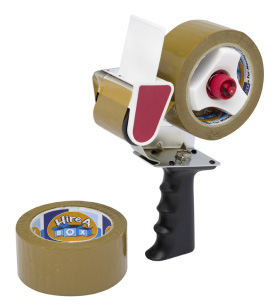
Loading a Packing Tape Dispenser


Packing tapes are essential in packaging and storing items. With packing tape, heavy boxes can be securely held together, and they can protect packages better than regular tape can. With a packing tape dispenser, not only can packing prove to be a seamless activity but it will help you accomplish things faster and more efficiently. Make sure you have rolls of packing tape on hand so refilling the packing tape dispenser is done quickly. In a few minutes, you can easily reload the packing tape dispenser. Here’s how:

1. Over the dispenser reel, place the roll of packing tape in such a way that it will unwind in a counter-clockwise manner.

2. Hold the front tab of the packing tape roll, pulling it at a downward angle through the slot between the dispenser roller and shield. There are also tape dispensers that have a shield to which you can pull down the tape and slide it through. Remember that the sticky side of the packing tape should always face downwards.

3. In an upward motion, simply pull the front tab of the tape so that the dispenser blade can cut through the packing tape. The blades of packing tape dispensers are sharp enough to cut through your skin so be careful in handling such packaging tools to avoid cuts and bruises.

4. To be sure that the packing tape dispenser functions perfectly, test it by unrolling just a small amount of tape and cutting it with the dispenser’s blade.

5. If the packing tape dispenser is not tight enough, adjust it by tightening the tension adjuster and set the unwinding feature at a comfortable and smooth level.

When handling such tools, always be careful and make sure that you are comfortable handling the packing tape dispenser, or any other packaging tool for that matter. BestPack.com is an online manufacturer of packaging equipment, such as carton sealers, and also offers nationally-acclaimed packing tapes ideal for the packaging industry.

Wednesday, January 19, 2011

Benefits of Case Sealers in the Workplace


Case sealers are part of the case erecting and final sealing cycle. This type of packaging equipment can perform overlapping flaps or sequential folding and can be used for both top seal only, or top and bottom seal. With the flap folding function and platen compression, professional looking and perfectly jointed flaps are well-aligned for a more attractive finish. Case sealers basically operate by sealing product filled cases with the top flaps either with tape or hot melt glue.

Case sealers come in uniform and random functions and are also available in semi-automatic and automatic models. As the terms suggest, semi-automatic case sealers still need the assistance of an operator to function while automatic case sealers are operator free models. Case sealers are great investments in the workplace and here are just some of the reasons why:

1. Case sealers are made from stainless steel that can be adjusted.
2. Owners can adjust the proper height and width for increased productivity.
3. Whether you choose a semi-automatic or an automatic case sealer, both models automatically fold the flap then tightly sealing the case.
4. Highly economical.
5. Dual masts with dual lead screws are added for added stability and height adjustments.
6. Case sealers can seal boxes and cases in different sizes and types.

With that in mind, case sealers greatly increase efficiency in the workplace by:

1. Reducing injuries for manually fed case sealers
2. Reducing labor yet increasing output
3. Tape waste is reduced as well
4. End product gets a more professional appearance
5. Material cost is also decreased, and finally
6. Case sealers create a professional-looking seal

And so when deciding to purchase a case sealer for your business, ask yourself if you want an operator-fed or operator-free case sealer. Also determine how many boxes should be sealed per production line per minute/hour. The carton sizes are also a factor in choosing the right case sealer as well as choosing between 2” and 3” case sealing tapes to seal the box. Finally, find out whether your business needs a top and bottom applicator, or just a top applicator.

Thursday, December 9, 2010

The Many Ways Products can be Packaged In


Different products require different packaging techniques. The most important factors to consider is the product itself and the degree of protection it needs in order to survive its transportation. Packaging is meant to protect products from shock, contain liquid; they must also abide by security and sometimes the packaging serves marketing purposes.

Blister Pack – Blister packing is for retail purposes. The product is served in a clear or opaque plastic or metal foil seal to hold it in place. This type of packaging provides individual protection which is especially useful for tablets, capsules, and even action figures. Other products are small consumer goods like electrical items, hardware, and toys. Manufacturers make the most of blister packs by incorporating marketing strategies such as placing company names at the back of the pack.

Tamper-Evident Packaging – Tamper-proof packaging is commonly practiced in the pharmaceutical and food industries to prevent the tampering of medical products such as pills and jars. The Food and Drug Administration has required induction sealing or cap sealing to hermetically seal the top of plastic and glass containers to help provide evidence of tampering. Shipping containers also have tamper-evident packaging to secure wholesale goods and items. Shrink-wrap is also an effective means to prevent tampering though it has always been overshadowed by other tamper proof packaging means.


Cardboard packaging – Cardboard is an inexpensive means of packaging items and goods. Aside from being abundant in supplies, cardboard packaging can be done with carton sealers or case sealers – machines that automatically or manually pack cardboards, which saves businesses time and money. This form of packaging is very popular for transport of consumer and commercial products. Some products that use cardboard packaging include cereals, liquid products like milk and orange juice, and even washing powder.

BestPack.com proudly offers case sealers to make packaging easier and hassle free. Choose from random, manual, and automatic case sealers or you can also have custom built carton sealers that are suited for your business.

Friday, November 26, 2010

Why You Should Invest in a Carton Sealer


Packaging is a key component of many businesses, especially if you are an e-commerce merchant. Presentation can oftentimes make or break your business reputation, so as an entrepreneur you have to put as much thought to packaging as you do your actual product. Here is where a carton sealer plays an important role. Carton sealers, also sometimes called case sealers or box tapers, are essentially machines that apply tape to the top and/or bottom of cardboard boxes. Thus, if your business requires packing products in a box, you need a carton sealer. There are several types available on the market, but they can be generally classified into two: manual and automatic. Depending on where you purchase it, a carton sealer can be quite an investment, and that is why some entrepreneurs are sceptical about buying one. However, keep in mind that successful businesses are all about good investments and a carton sealer is one.

If you are an entrepreneur who has yet to purchase a carton sealer for your business, here are a few reasons why you should:
1. A carton sealer eliminates the need to seal or tape boxes by hand. Manual sealing is a time consuming chore (notwithstanding the trial and error involved when sealing a carton by hand) and in business, time is money. Additionally, sealing or taping by hand can result in inconsistently packed boxes. Poorly presented boxes like those that often occur when you try sealing a carton by hand make your business look bad, and your product will look as if it were of low quality. You need to have a consistent and presentable look for your products and a carton sealer will help you effectively achieve this.

2. A carton sealer may initially cost you upwards of a few thousand dollars, but in the long run, it is bound to improve efficiency in your packaging line. It is a time saver, a money saver, and even a space saver.

3. A carton sealer can be customized to your unique business needs. Boxes come in different sizes and even shapes and a carton sealer can be adjusted to the particular specifications you need.

Once you are ready to purchase a carton sealer, make sure you do from a reliable carton sealer provider with a track record of excellence like Best Pack.

Wednesday, October 20, 2010

Product Packaging with Case Sealers


Packaging products within a container or package serves many purposes which includes protection and marketing. Even if the final customer decides to purchase a product without a package, the product distributor and manufacturer still need to package products to ship safely to the store. There are basically two types of packaging that products go through before being sold to the final customer. With efficient case sealers, product packaging is both economical and less time consuming.
The first type of product packaging is the Final Customer Package. This is basically the primary package to which the consumer is exposed to upon making the purchase. The primary package is the outermost container that the final customer sees and touches. It can be divided into three parts:

• First-level package – this is the package that holds the actual product. Sometimes, the packaging is only minimal since it only serves to protect the product. For example, frozen goods can be sold in cardboard boxes with the product contained in a plastic bag that is inside the cardboard box.
• Second-level package – this could be the primary package if the first-level package is surrounded by one or more outer packages. In essence, it’s just another package that holds the first-level package.
• Package inserts – Nowadays, packaging products are not just for protection purposes. Marketers use packaging to communicate with consumers even after they’ve purchased the product. Often inserted within or on the product itself, package inserts include instruction manuals, warranty cards, promotional incentives, and software.
The Distribution Channel Package is the second type of product packaging, which involves how the products are packaged to the supply chain. It can hold multiple customer packages and that is why it offers a higher level of damage protection as compared to customer packaging.

Whether business owners choose a final customer package or a distribution channel package, using case sealers are the most efficient and low-cost means of doing so. Not only do case sealers save time and money, but case sealers are also durable and reliable.

Wednesday, September 8, 2010

Some Tips to Ensure Safety in the Packaging Workplace


Packaging equipment manufacturers are being pressured to create more flexible packaging machines that are able to meet the high demands of consumers. With the challenge of incorporating additional automation into case sealers and other packaging machinery, case sealer manufacturers must integrate these new features while balancing complex safety issues. Uniting flexibility while ensuring the safety of case sealer operators is a task that machine builders are ready to face – but how?
The demand for more flexible case sealers and packaging machines arose from shorter innovation cycles and increased pressure from the competition. This resulted in the decrease of batch build and multi-pack runs. Because of this, case sealers are now required to produce multiple packaging variations from the same machine. For example, BestPack’s MSDBF Pack/Seal Total System is equipped with top/bottom sealers, extended sidedrive systems, and top and bottom horn flaps for easier case sealing. By not having to buy additional accessories and saving on case sealer with such flexibility, clients may worry that this may compromise quality and safety. However, this is certainly not the case.

Keep in mind that all case sealers being manufactured are required to pass industry standards. Case sealers and other packaging equipment machines also require multiple axis controllers and other motion control products for safety processes to run easily and quickly. Deployed properly, clients can expect an increase in production while achieving the required flexibility their packaging needs, and still ensure the safety of case sealer operators.

When considering the safety of adding motion products to case sealers, one should consider synchronization of decentralized drives, management of dynamic drives, camshafts for additional functions, manufacturing at a consistent quality but with low cost, quick installation and flexibility, and automatic adjustment for variations in products. All of these are part of a complete automation solution.

The most essential thing to remember is that proven motion solutions are available that can meet the demands of the industry when it comes to flexible and safe packaging machinery.